Research
What to prepare before licensing your company's data
A useful first inquiry explains who controls the data, what it contains and how it could be assessed. A small review of ten public data-supply programs found different starting points: an interest form, an account, a listing request, a meeting request or an estimate. Eight programs supplied readable preparation information. Their published processes show why the details needed to start a conversation can differ from those needed for assessment or listing.
For a company considering a first data partnership, the practical result is a short preparation brief. Describe the company and its decision-makers, the dataset and its history, and the permissions and restrictions that need resolving. Add detail as the provider's review progresses.
A first form tells you where the conversation begins
The first public action can look simple even when the provider describes a more detailed review later.
Neudata's listing page describes an initial request with company and contact details. Analyst approval comes before building the listing, and its published sequence places a due diligence questionnaire or risk check after approval. Someone preparing only for the first form would miss the product description and diligence that follow. Neudata's listing process
Defined.ai's public sequence starts with creating a Jira account. Later stages cover commercial opportunities, data quality, volume, organization, metadata, licensing rights and compliance. The account step therefore provides little information by itself about the material a data partner should be ready to discuss. Defined.ai's partnership program
Other programs put dataset questions in the public form. OpenAI asks about data type, estimated size with units, format, sharing rights and help needed to prepare the data. Shutterstock asks about the kind of content controlled and the size of the library. OpenAI's interest form, Shutterstock's Data Partner Network
The distinction changes how to prepare. Use the entry form to identify the next action, then read the provider's explanation of assessment and onboarding. A contact request, an approved listing and an agreed license are different outcomes.
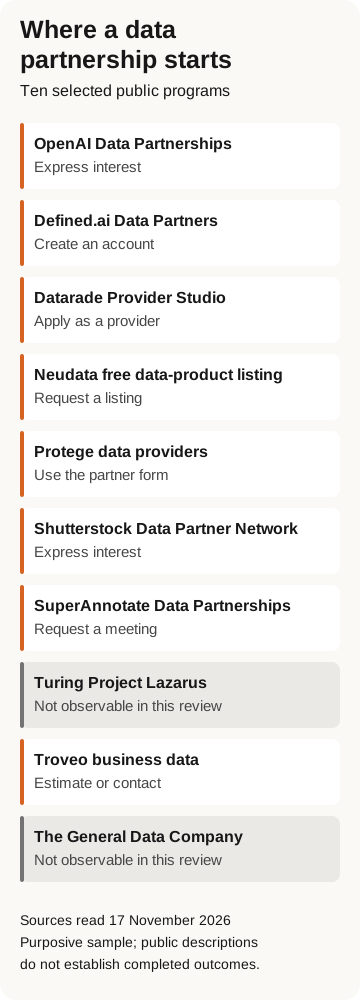
Public entry routes read on 17 November 2026. The case table links each observation to its source.
Describe the dataset in the units that explain it
“We have several terabytes” leaves important questions unanswered. A description should let the recipient understand what those bytes represent and whether the records have useful context.
The inspected OpenAI form explicitly requests units for estimated size, giving words and hours as examples. Shutterstock's library-size field fits a content collection. These are different ways of describing scale, so a single storage-size number is unlikely to serve every inquiry. OpenAI's form, Shutterstock's form
Operational records need another kind of description. Troveo's business-data page discusses systems, team size and operating history, and describes links within conversations, document metadata and project histories. SuperAnnotate's examples include communications, process documents, decisions, domain records and recorded work. Both pages make the work represented by the records part of the description. Troveo's business-data page, SuperAnnotate's data partnerships
For an initial brief, record the content type, approximate amount, date range and source systems. Add the context that makes the records understandable: whether messages retain their threads, whether documents have version history, or whether a dataset includes a field dictionary. Neudata's public guidance specifically recommends supporting materials such as data dictionaries to explain a data product. Neudata's provider guidance
Here is a fictional example of a useful description:
An archive of equipment-maintenance records covering three years, with approximately 80,000 work orders. Each record links a reported fault, inspection notes, the repair performed and the closing status. The archive can be exported as structured tables with a field dictionary. Attachments and identifying fields have not yet been reviewed for inclusion.
Separate control of the files from permission to license them
Prepare a clear account of where the records came from and who can authorize the proposed use. Keep unresolved permissions visible so the conversation can address them.
OpenAI's interest form asks whether the applicant has rights to share the data. Datarade's provider page describes commercialization rights and restrictions on personal data as eligibility considerations. Defined.ai describes licensing-rights and compliance checks as part of its evaluation. These are public requirements or questions from those programs; answering a form does not establish that a dataset is legally cleared. OpenAI's form, Datarade's provider requirements, Defined.ai's review process
Your preparation brief can identify the proposed licensor, how the data was created or obtained, any relevant agreements, and restrictions already known to the team. It can also identify who needs to resolve remaining questions. Keep that description separate from a claim that all rights have been verified.
Scope matters here too. The intended data package may cover one time period, system or collection rather than everything the organization holds. Describing the proposed boundaries makes the next discussion more concrete. It also helps distinguish a representative sample from a complete transfer.
Use a short brief, then add the requested evidence
The worksheet groups the observed questions into three practical sections. This grouping is our synthesis of the pilot.
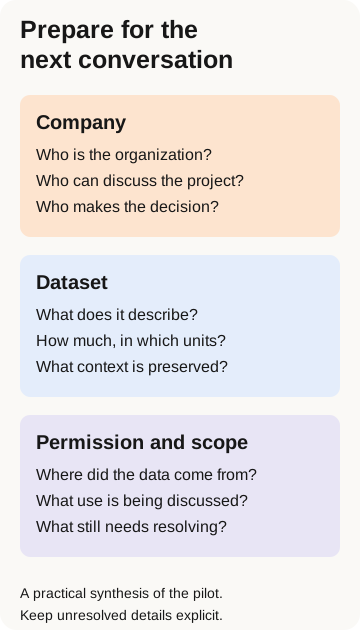
| Section | What to prepare |
|---|---|
| Company and decision-makers | Organization, domain, relevant operating history, contact and person responsible for the proposed partnership |
| Dataset and preparation | Content types, approximate amounts with units, date coverage, systems, formats, available metadata and work needed for assessment |
| Permission and scope | Source of the data, proposed licensor, known restrictions, permitted uses to discuss and unresolved approval questions |
Use “unknown” where a detail is unresolved. An estimate should include its unit and how it was produced. A statement about rights should identify its basis rather than treating possession of the files as proof.
For example, “approximately 4,000 hours, estimated from the media-library index” is more useful than “large video archive.” “Our team needs to review contributor agreements for this use” is more useful than an unsupported declaration that the entire archive is cleared.
The next step depends on the program. SuperAnnotate describes a scoping call followed by sample assessment; Datarade describes application review before profile creation and product publication. Ask what the next review needs and use the agreed process for any material you provide. SuperAnnotate's stated process, Datarade's application process
Download the preparation worksheet. The observations and analysis script let readers inspect the source mapping and reproduce the pilot's counts.
How we ran the pilot
We selected ten programs to cover different kinds of public intake: OpenAI, Defined.ai, Datarade, Neudata, Protege, Shutterstock, SuperAnnotate, Turing Lazarus, Troveo and The General Data Company. This was a deliberate selection of varied cases, not a random or comprehensive sample of data buyers.
On 17 November 2026, we read official English program pages and relevant public explanations through web extraction. Eight supplied substantive information about preparation or entry stages. Turing Lazarus's program body and The General Data Company's partnership route could not be read through that method. They remain unknown in the dataset. Protege's embedded form and Neudata's linked form were also not readable, although their public pages described the entry routes.
We did not enter personal information, create accounts, submit applications, upload data or test field validation. Public statements describe what providers say; they do not establish completed reviews, acceptance, transaction prices or customer outcomes. Search retrieval may use indexed copies, and pages can change. The complete methods and case table identify the inspected scope and each access limit.
For help scoping a possible data project, see supplying data to Sapien1.